 Skip to content
Stump Grinding vs Stump Removal: Which One Do You Actually Need?
Once a tree has been felled, the stump it leaves behind is frequently treated as a minor issue to be dealt with later – and then discovered to be more consequential than expected when the homeowner tries to replant, level the ground, build over the area, or simply mow over the root zone. At NexGen Tree Services, stump grinding is a service we provide alongside or separately from tree removal, and the question of whether to grind or remove the stump – and when to do it – comes up with almost every removal job we do.
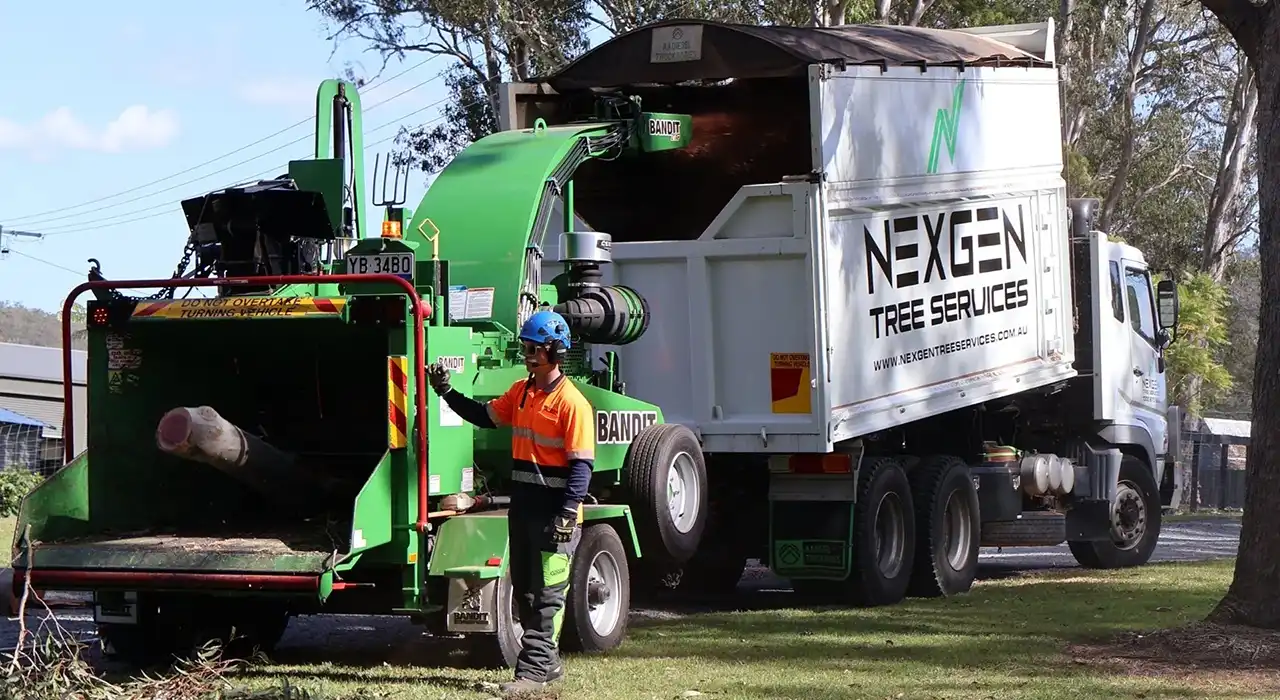
What Stump Grinding Involves
Stump grinding uses a specialised machine fitted with a hardened steel cutting disc to reduce the stump to wood chips in place. The grinding process works systematically across the stump, reducing it to a depth typically between 150 and 300 millimetres below ground level, depending on the equipment used and the depth required for the intended use of the area. The material produced by grinding – a mixture of wood chips and soil – remains in the hole, which gradually settles and consolidates over months as the wood material decays.
Stump grinding does not remove the lateral roots that extend outward from the stump into the surrounding soil. These roots remain in the ground and decay over time – a process that takes months to years depending on the species and size of the tree. Surface roots close to the stump may be visible for some time after grinding.
What Stump Removal Involves
Stump removal, also called stump extraction, involves physically lifting the entire stump and its root ball out of the ground. This is typically done with an excavator or, in the case of NexGen Tree Services, with our SENNEBOGEN 718 E tree handler, which can grip and extract stumps that would otherwise require significant excavation. The result of stump removal is a hole that must be filled with suitable material, but it leaves no woody material in the ground to decay over time.
Stump removal is a more intrusive and typically more expensive process than grinding. It disturbs a much larger area of soil and requires fill material to be brought in and compacted before the area can be used. For most residential applications, it is more disruptive than the situation warrants.

When Stump Grinding Is the Right Answer
Stump grinding is the right choice for the great majority of stump situations on Gold Coast residential and commercial properties. Where the area around the stump is to be turfed, replanted with garden beds, or left as lawn, grinding to 150 to 200 millimetres below the surface is sufficient for the surface to be covered with new turf or planting mix and for grass or plants to establish successfully above the decaying grinding material.
Where a path, driveway, or lightweight structure is to be installed over the stump area, grinding to a greater depth is advisable to avoid future settlement as the woody material decays. NexGen can advise on the appropriate grinding depth for specific applications.
Grinding is also generally the right answer when the stump is in a location where access for heavy extraction equipment would be difficult or where the surrounding garden, lawn, or structures make the disturbance of a full extraction unacceptable.
When Stump Removal Makes More Sense
Stump removal is the better choice in a smaller number of specific situations. Where a significant structure is to be built directly over or very close to the stump area – a slab, a pool, or a major retaining structure – full removal of the stump and root ball eliminates any risk of settlement or void formation as organic material decays beneath the structure. For applications where the ground must be genuinely clear of organic material, such as certain landscaping designs requiring deep fill or significant earthworks, removal is preferable to grinding.
Some species with aggressive regrowth characteristics – including certain fig species and some exotic trees – may produce suckers from lateral roots even after grinding. For these species, a systemic herbicide treatment of the stump prior to or immediately after grinding is typically more effective than full removal at preventing regrowth, but in cases where the regrowth risk is considered unacceptable, full removal addresses the issue more definitively.
Timing: Why Doing It at the Same Time as Removal Is Usually Best
The most practical and cost-effective approach to stump grinding in most situations is to have it done at the same time as the tree removal. When NexGen Tree Services fells a tree, our grinding equipment is on site, the area around the stump is clear, and the access that has been established for the removal job is still available. Returning for a separate grinding visit involves a new mobilisation cost and may require re-establishing access that is no longer clear once vegetation has been managed or other works have been completed around the stump.
Contact NexGen Tree Services
NexGen Tree Services provides stump grinding across the Gold Coast with equipment capable of accessing tight residential locations. Our SENNEBOGEN 718 E also gives us stump extraction capability that most Gold Coast tree service providers cannot match.
Call us on 1300 675 895 to arrange a quote for stump grinding, stump removal, or combined tree removal and stump grinding.
